

The best time to visit Om Parvat is from May to October, when roads are open and weather conditions are suitable for travel. During these months, the region experiences relatively stable weather, making it easier for pilgrims to reach the Om Parvat viewpoint. Summer months offer clearer skies, while September and early October usually provide better visibility after the monsoon. Winters are not suitable due to heavy snowfall and road closures. Since the ॐ symbol depends on natural snow patterns, visibility may vary even during the best season.
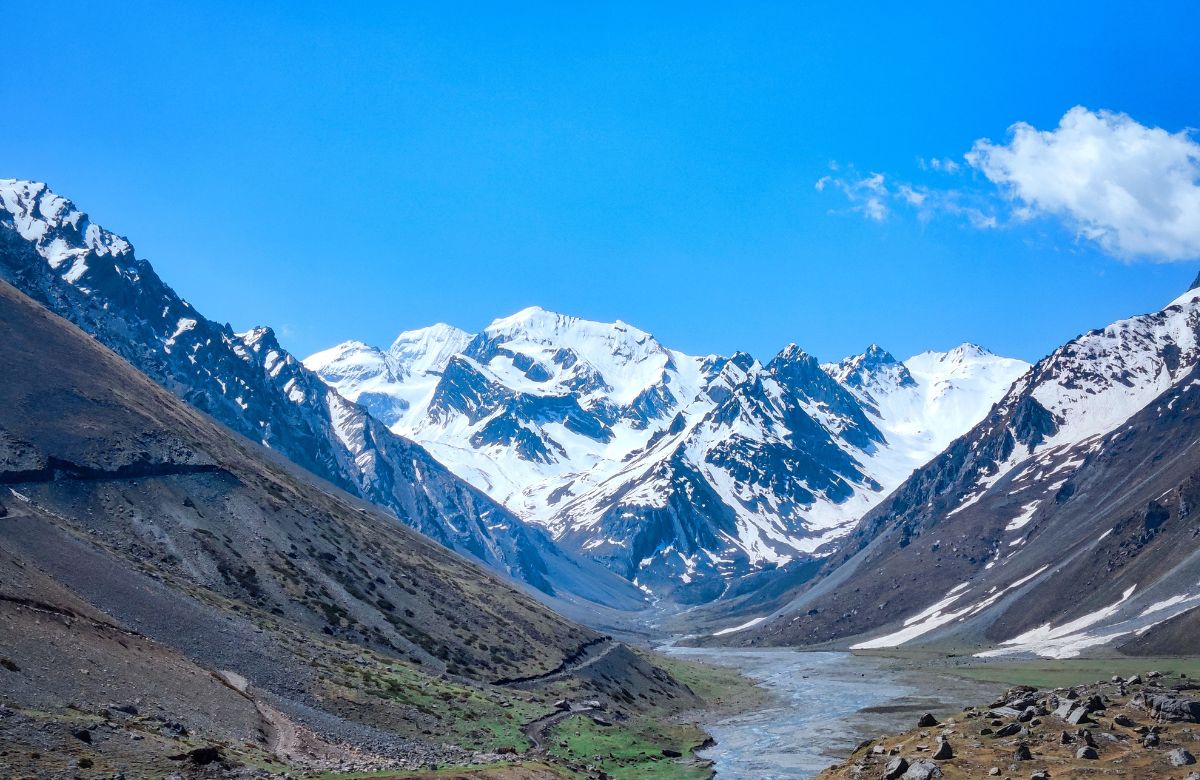
The history of Om Parvat is closely linked to Shaivism and Himalayan spiritual traditions. In Hindu belief, ॐ (Om) is considered the first sound of the universe. Ancient religious texts and local traditions say that the Om symbol represents creation and spiritual energy. At Om Parvat, this sacred symbol appears naturally on the mountain due to snow patterns, which makes the place very special for devotees.
It is believed that Lord Shiva, pleased by the devotion of a sage named Ashtavakra, manifested the “Om” symbol on the mountain.
Historically, the region around Om Parvat remained remote and largely inaccessible, visited mainly by local communities and dedicated pilgrims. With improved road connectivity in recent years, Om Parvat has become more accessible, while still retaining its spiritual and untouched aura.
Despite being called a trek, Om Parvat is primarily a road journey with minimal walking.
Reaching Om Parvat from Delhi requires travelling by train and bus. Most pilgrims first travel from Delhi to Kathgodam by overnight train, as it is the nearest major railhead. From Kathgodam, the journey continues by road to Pithoragarh and then onward to Dharchula. After Dharchula, the route passes through Gunji and Nabi villages before reaching the sacred Om Parvat viewpoint.
If you are starting from Dehradun, Om Parvat can be reached either by road or by flight combined with road travel. Dehradun has air connectivity to Pithoragarh which helps reduce travel time. Alternatively, pilgrims can travel by road from Dehradun to Pithoragarh, followed by Dharchula. From Dharchula, the route to Om Parvat remains the same via Gunji. This option is preferred by travellers who want flexibility and are already in Uttarakhand.
Pithoragarh is the closest major town to Om Parvat and serves as the main gateway for the Adi Kailash Yatra with Om Parvat trek. From Pithoragarh, pilgrims travel by road to Dharchula. After completing permit formalities at Dharchula and Gunji, the journey continues towards Nabi village and the Om Parvat viewpoint. Pithoragarh is the most convenient option for those already travelling within Uttarakhand.
Located at a height of 5570 metres, Om Parvat weather remains typically cold.
Here, the weather changes pretty quickly, therefore pilgrims are recommended to carry warm clothing even in summer.


